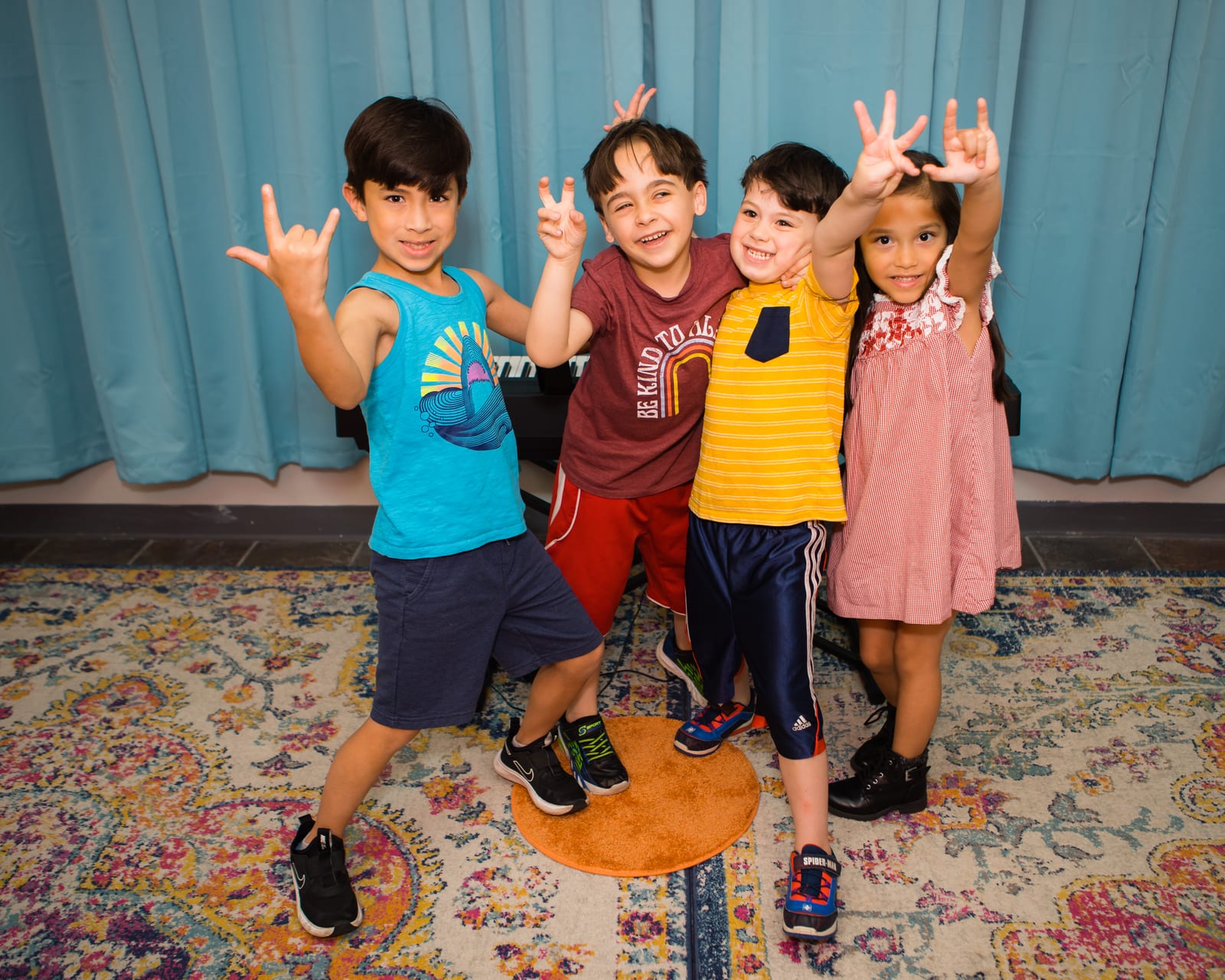
Little Tones at Twelve Tone Music School in Glenview, IL is a small-group, early-childhood music program built specifically for kids ages 4 and 5. Each class lasts 45 minutes, runs weekly, and is led by a professional musician trained to teach preschool-age children. The format isn't a watered-down adult lesson and it isn't a free-play music time — it's a structured introduction to rhythm, pitch, ensemble play, and the social side of music, in a room with peers exactly the same age.
What is Little Tones at Twelve Tone Music School?
Little Tones is the Twelve Tone program for the youngest students — kids ages 4 and 5. The class meets weekly in the Twelve Tone Glenview studio, with a small group of peers all at the same developmental stage. Each session is 45 minutes, taught by a working musician with experience teaching early childhood, and built around real musical concepts: steady beat, pitch matching, call-and-response, simple notation, and ensemble awareness.
Little Tones is the bridge between "my kid likes music" and "my kid takes piano lessons." By the time graduates step into Piano Lab at age 6, they already know how to follow a teacher, listen to peers, and feel a beat — which is most of what makes lessons stick.
What does a typical Little Tones class look like?
A Little Tones class moves through several short activities, because 45 minutes is a long time for a 4-year-old to focus on one thing. The arc of a typical class:
- Opening circle — instructor leads a hello song, kids greet each other, the class warms up vocally.
- Beat work — clapping, stomping, body percussion to a steady pulse. Builds the foundation everything else sits on.
- Hands-on instruments — kids try shakers, boomwhackers, drums, or mini keyboards. Different week, different instrument.
- Pitch + listening — call-and-response singing, simple matching games, identifying high vs. low sounds.
- Group song — the class learns a short piece together, taking turns leading and following.
- Closing circle — a goodbye song, sometimes with a take-home sticker or stamp tied to the lesson theme.
What instruments do Little Tones kids actually play?
Twelve Tone's Little Tones curriculum rotates through a wide range of kid-sized instruments so kids encounter the full musical universe before specializing later. The instrument roster includes:
- Shakers, tambourines, and small percussion — for steady-beat work.
- Boomwhackers (colored tuned tubes) — for pitch and chord recognition.
- Hand drums and tubanos — for rhythm patterns and call-and-response.
- Mini keyboards — for first-piano exposure, two-handed coordination.
- Voices — the class sings constantly. Vocal play is core to the curriculum.
Why is the group format better than solo lessons for ages 4-5?
Twelve Tone runs Little Tones as a small group because that's how 4 and 5 year olds actually learn music. At this age, kids learn by watching peers, imitating, taking turns, and playing together — much more than by sitting one-on-one with an adult. A group format gives them models (other kids) and a real audience (other kids) and a reason to show up next week (their friends).
Solo lessons for kids this young tend to feel like extra preschool — a child sitting still, doing what one adult says, for 30 to 45 minutes. The dropout rate is high because the format fights against how the age group is wired. Little Tones uses the group dynamic as the engine, not the obstacle.
How is Little Tones different from a daycare music time?
Daycare or library music programs are usually free-play formats — kids bang on things, sing songs, have fun, no real progression. That's wonderful and serves a different purpose. Little Tones is structured. Each class builds on the previous one. Kids learn specific concepts (steady beat, high/low pitch, AB rhythmic patterns, call-and-response form) on a curriculum that gets them ready for actual instrumental study at age 6.
Twelve Tone Little Tones instructors are working professional musicians, not generalist preschool teachers. The musical content is real. The format is just developmentally appropriate.
What does my child take home from Little Tones?
Beyond the musical concepts, Little Tones graduates carry three things into their next chapter at Twelve Tone (and beyond): a comfortable relationship with making music in a group, a developed ear for beat and pitch, and a felt sense that performing is normal and fun. These are precisely the foundations that make Piano Lab work at age 6.
Parents often notice that Little Tones graduates sing more freely at home, identify songs on the radio more quickly, and clap along accurately when music is playing. None of those are explicit lesson goals — they're side effects of regular musical engagement at the right developmental window.
How do kids transition from Little Tones to Piano Lab?
Twelve Tone designed Little Tones to feed directly into Piano Lab, the school's group piano program for kids ages 6 and up. The transition is intentional: Little Tones grads already understand the social contract of a group class, already follow a beat, already match pitch. Stepping into Piano Lab feels like a natural next step, not a foreign experience.
Families who want to start Piano Lab a few months before their child turns 6 can talk to Twelve Tone about it — the school evaluates readiness on an individual basis, not strictly by birthday.