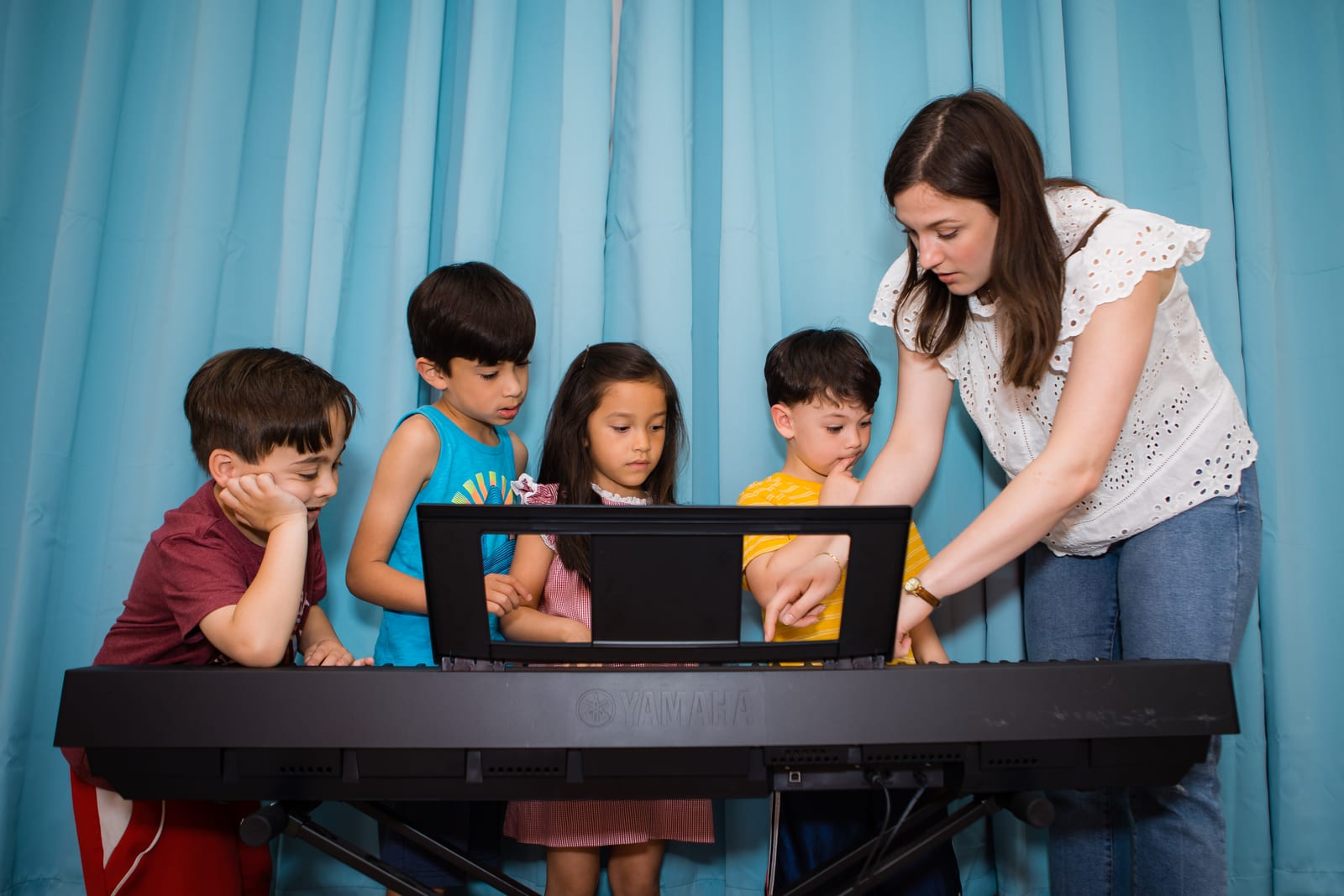
Twelve Tone Music School in Glenview, IL gets asked the "when should my kid start piano lessons" question more than any other. The honest answer: most kids are ready for structured piano lessons around age 6, but the right starting point depends less on a birthday and more on whether your child can sit, follow instructions in a group, recognize letters and numbers, and stay interested for 45 minutes. Here's how to tell whether your child is ready, and what to do based on their age.
What age can kids actually start piano lessons?
Twelve Tone recommends starting structured piano lessons at age 6 for most children. Piano Lab — Twelve Tone's group piano program — is built for kids 6 and up, and that's the age where group instruction tends to click cleanly. Kids 4 and 5 can absolutely engage with music, and Twelve Tone offers Little Tones for that age group, but the bridge into note-reading piano works best when basic literacy and longer attention are already in place.
That said, kids develop at different rates. Some 5-year-olds are ready. Some 7-year-olds aren't quite there yet. Age is a starting point for the conversation, not the answer.
What are the signs my child is ready for piano lessons?
Twelve Tone instructors look for four readiness signs when evaluating whether a kid is ready to start piano lessons:
- Letter and number recognition — the child can identify A through G and count to 10 reliably, since both alphabet letters and finger numbers come up in the very first lessons.
- Following multi-step instructions — "put your left hand on this key and then your right hand on that key" is a multi-step ask, and the child can stay with it.
- Sustained focus — the child can stay engaged with one activity for at least 15 to 20 minutes without needing to switch.
- Genuine interest — the child has shown some unprompted curiosity about music, or has been asking. Forced lessons usually don't stick.
Should my 4-year-old start piano lessons?
Twelve Tone does not recommend starting structured piano lessons at age 4. The attention span and literacy gap is real — most 4-year-olds will struggle to stay engaged with the format and end up frustrated rather than excited. The wrong start at age 4 can sour a kid on piano for years.
What Twelve Tone recommends instead at age 4 is Little Tones — a group early-childhood music program that builds the foundations (beat, pitch, listening, ensemble play) without trying to formalize piano too early. Kids who do Little Tones at 4 and 5 step into Piano Lab at 6 with a real head start.
Should my 6-year-old start piano lessons?
Yes — age 6 is the sweet spot for starting piano at Twelve Tone. By 6, most kids have the literacy, attention, and motor skills that group piano requires, and they're still young enough that practice can feel like play rather than work. Six is the age Twelve Tone built Piano Lab around.
The decision at this age is usually about format — Piano Lab (group) vs. Private Lessons. For most 6-year-olds, the group format works better because peers create accountability and energy that one-on-one lessons can't. Private piano at age 6 is fine, but it doesn't have the same engagement leverage as the group format.
Should my 8 or 10 year old start — or have we waited too long?
Twelve Tone has plenty of students who started piano at 8, 10, or even older — and they do not have any inherent disadvantage. The myth that there's a hard window after which piano can't be learned is wrong. What older starters get is an advantage in focus, literacy, and the ability to understand what's being asked of them. The trade-off is the early childhood years of music exposure they don't have, which younger starters do have.
Net: older starters often progress faster early on, then converge with younger-starters by the second year. Starting at 10 is great. Starting at 14 is great. Starting in adulthood is great. The right age to start is when the child wants to start.
What's the difference between group piano and private piano for beginners?
Group piano (Twelve Tone's Piano Lab) puts a small group of kids at the same level on four school-provided keyboards, taught by a working pianist. Students learn the same material at the same pace, see peers struggle with the same things, and develop the social side of music alongside the technical side. Most Piano Lab students progress faster than traditional private students, because the group energy makes practice between lessons feel like keeping up with friends rather than homework.
Private piano (Twelve Tone's Private Lessons) is one-on-one, fully customized to the student's pace and interests. The format suits kids who want to push deep into one style, kids who need extra attention, and kids who genuinely thrive with focused individual time. It's a better fit for advanced students or for very-young students who need a slower pace.
Many Twelve Tone families do both — Piano Lab for the group experience, plus a private lesson once a month or every other week to dig into a specific song or technique.
How does Twelve Tone decide when a kid is ready?
Twelve Tone evaluates readiness on an individual basis during the free trial class. A 5-year-old who can sit, listen, and engage might be ready for Piano Lab. A 7-year-old who's bouncing off the walls might be better served by another six months of Little Tones first. The trial class — same length and format as a real Piano Lab session — is the most reliable test.
Parents who aren't sure can book a free trial class. Twelve Tone instructors will be honest about what they observed and whether to start now or wait. The school's incentive is long-term success, not maximum enrollment.